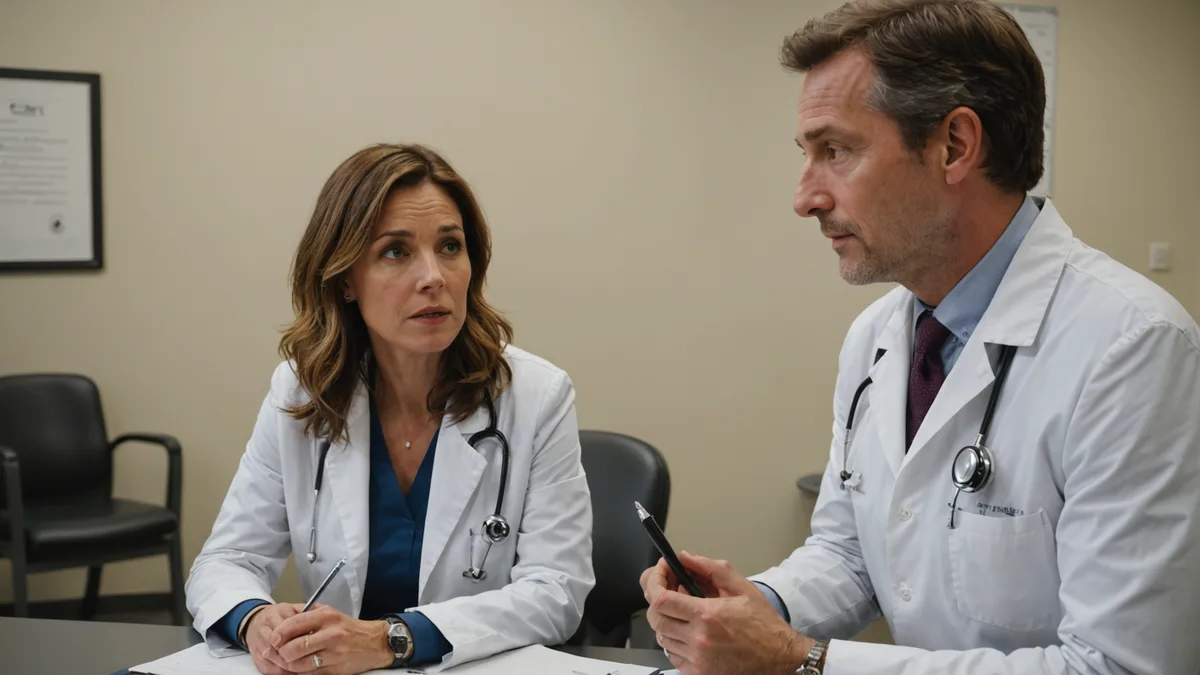
Fifteen minutes is less time than most people think. Before you factor in the time for the doctor to review your chart, ask the initial history questions, complete any physical exam, and document the visit in the electronic health record, the window for actual back-and-forth conversation is probably closer to eight or ten minutes. This is not a criticism of how healthcare is structured. It is just the reality of how primary care appointments work in most US practices today.
Given that constraint, the difference between a productive appointment and one where you leave feeling like you did not get to what matters most is almost entirely determined by what you bring in and how you open the conversation.
The first 60 seconds are the most important
Research on medical consultations has consistently shown that the first thing a patient says after the doctor's opening question shapes the entire direction of the visit. Patients who begin with their most important concern, stated clearly, tend to have appointments that address that concern. Patients who begin with a secondary issue, or who lead with context and work up to the main point, often run out of time before reaching it.
Prepare a one-sentence summary of why you are there before you arrive. Not a long narrative, not a list of everything you want to cover, but the single most important thing you need addressed at this visit. Lead with it when the doctor asks what brings you in. The remaining eight minutes will organize themselves around that opening more effectively than around almost any other conversational strategy.
Prioritize before you arrive, not in the exam room
Most people arrive at a primary care appointment with several concerns. Under time pressure in the exam room, it is hard to rank them clearly. The better approach is to rank them before you go.
Write down everything you want to discuss. Then identify the one concern that, if left unaddressed, would make this appointment feel like a failure. That is your first concern. The others are important but can be handled in descending priority, or deferred to a follow-up if there is not time. You are not surrendering your other concerns by prioritizing. You are making sure the most important one gets addressed in the time available.
If you have several active issues that genuinely cannot be triaged, call the office before the appointment and ask whether a longer or double appointment slot is available. Many practices offer them for complex visits. Mentioning that you have multiple concerns when you schedule reduces the chance of running out of time on the day.
Come with information, not just questions
The structure of a medical appointment puts the doctor in the role of asking questions and the patient in the role of answering. But a prepared patient can shift that dynamic by arriving with organized information rather than waiting to reconstruct it under questioning.
A brief written account of your current symptoms, when they started, how they have changed, what makes them better or worse, and how they affect your daily life is more useful than your best effort to recall all of that in real time while the doctor is taking notes. You can hand it to the nurse when you check in, or hand it to the doctor directly at the start of the visit. Providers who work with patients who come prepared tend to find the visit more efficient, not less.
Your current medication list falls into the same category. Having it written down or in a notes app you can pull up immediately prevents the slow reconstruction of "I think I take something for blood pressure, I do not remember what it is called" that can consume significant appointment time.
Do not save the most important question for the end
The "doorknob moment," when a patient asks the real reason for the visit just as the doctor's hand is on the doorknob, is well known in clinical practice and documented in patient-physician communication research. Patients save their most important concern for last because they feel they need to establish trust first, or because the concern feels embarrassing, or simply because that is how the conversation evolved.
The practical cost of this pattern is that the concern gets the least time and attention of anything in the visit. If you have a concern that you have been putting off raising, that concern belongs at the beginning of the appointment, not at the end. Leading with it does not require a preamble. "The main thing I wanted to talk about today is X" is a completely appropriate opening that orients the doctor immediately toward what matters most.
Ask for a closing summary
Before the doctor leaves the room, ask for a closing summary of the two or three most important things you should take away from the visit. Some doctors do this naturally. Many do not. Asking for it directly produces a concise final statement that significantly improves recall of the key points.
A closing summary also functions as a check: if the doctor summarizes the plan and it does not match your understanding of what was decided, this is the moment to say so. Mismatches that are identified in the exam room take thirty seconds to resolve. Mismatches that make it home tend to compound.
What happens after matters as much as the visit itself
A productive appointment is worth nothing if you leave without a clear record of what was decided. Notes taken in the exam room are better than nothing. A recording or a written summary is better than notes. A structured summary that separates diagnoses, medications, action items, and follow-up instructions is better still.
The work of a 15-minute appointment does not end when you leave the room. The medications you start, the follow-up you schedule, and the warning signs you watch for are the actual outcomes of the visit. What was said in the room is only the plan. Whether the plan gets executed depends on how clearly you carry it forward.
Kin captures what was said at your appointment and delivers a clear summary before you leave the parking lot. Try it free at your next visit.